

Care Portal News: How to Read the Updated WCAG 3 Draft
2026-11-02
Care Portal News: How to Read the Updated WCAG 3 Draft
People maintaining a care portal need to follow accessibility developments while still explaining the evidence behind the portal they operate today. W3C’s September 2026 update to the WCAG 3 Working Draft makes that distinction especially useful. The update invites review of work still under development; it is not a finished replacement standard. This article checks the official WAI material on November 2, 2026, and discusses how a care-service team can read the announcement without losing track of its current review work. No care portal or robot interface was tested for this article.
The update is an invitation to examine developing work
The WAI announcement dated September 10, 2026 identifies an updated WCAG 3 Working Draft and points readers to background and questions for review. The official WCAG 3 introduction says the draft is incomplete and will change. It describes a different structure and conformance model, and explains the continuing relevance of WCAG 2.
A care-service team can therefore read the draft to understand the direction of the work and contribute considered feedback. It should preserve the document’s status when sharing a summary. Removing the word “draft” would change the meaning of the announcement and could mislead colleagues about what has been finalized.
The introduction is also a useful place to check for later explanations. A copied fragment from one discussion can quickly lose its surrounding qualification. A maintained source reference helps a reviewer return to the organization’s own description rather than rely on an isolated slide or a headline.
Give present observations their own place
Consider a hypothetical care portal team already collecting feedback about a service-information page. A user’s difficulty completing a specific task is valuable information in its own right. The team can record the task and observation without waiting for a future guideline structure to settle.
Its review file should identify what was actually examined, which criteria or method the team used, and what remains uncertain. A note about a developing proposal can sit beside that file as research material. It should not silently replace the basis on which a previous review was conducted.
Nor should a draft reading create a fictional result. If a team has only discussed a proposed requirement, it cannot report that the live portal passed a test. Discussion, observation, and evaluation are different activities. Keeping them distinct protects the usefulness of both current evidence and future-facing research.

Turn a draft question into focused feedback
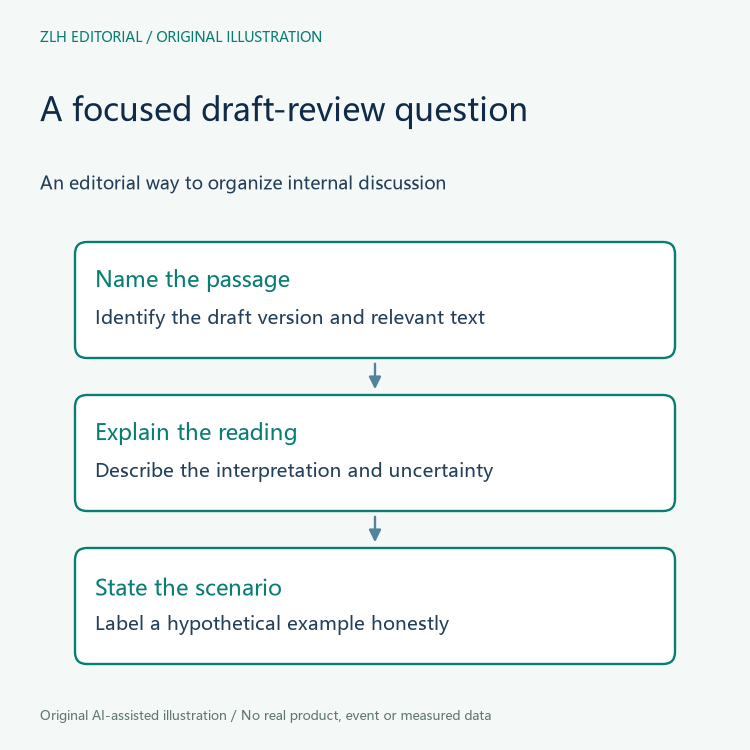
A constructive review comment can name the passage being discussed, explain the reader’s interpretation, and describe where that interpretation becomes unclear in a stated scenario. For example, the hypothetical team might ask how a proposed reporting approach would communicate partial progress across several service pages. This is a suggested question, not a claim that the draft mandates a particular organizational process.
A scenario should remain clearly hypothetical unless supported by real research that the team is authorized to share. Do not invent older participants, quotations, completion rates, or usability findings to make a comment look persuasive. A carefully framed interpretation question can be useful without an invented study behind it.
If real feedback is later included, appropriate permission and privacy handling belong to that actual activity. This article does not collect such feedback or send comments to a standards group. It only explains how an internal reading note can keep its question connected to the relevant draft.
Preserve the boundary with equipment and care claims
A web accessibility publication should not be repurposed as proof of a robot’s physical usability, safety, or clinical effectiveness. Those claims concern other objects and need evidence appropriate to them. A care portal can be associated with a robot service without turning every web-content review into an assessment of the machine.
When a supplier mentions the new draft, ask what it is actually claiming: participation in research, a planned design direction, or an evaluation of specific content. Then keep the response at that scope. A broad logo or slogan cannot explain which page, interaction, or service arrangement has been examined.
A draft-reading log can also distinguish the date of an internal discussion from the date of the source it examined. If the source later changes, the team can revisit its interpretation while retaining the earlier question. That makes an unresolved discussion understandable to a new colleague without pretending that an evolving proposal had a settled meaning from the start.
The two illustrations are original conceptual reading aids. They contain no real participant data, medical advice, or certification result. Related articles in our care robot portal section discuss web information and interaction questions, while the reading directory collects further topics. Following WCAG 3’s development can inform thoughtful planning while the team continues to document the actual accessibility work it undertakes today.


