

Care Portal Practice: Disclosure Is Not Form Submission
2026-11-02
Care Portal Practice: Disclosure Is Not Form Submission
Disclosure controls reveal or hide additional information. On a care-robot information portal, opening explanatory content should not automatically be described as saving a request or completing a service action. This practical article proposes a reading exercise for a fictional page concept. It opens no real form, records no personal information, and makes no finding about a care service. The learner’s task is to explain what each control is intended to do.
Separate reading help from sending information
Begin with a proposed section that offers additional explanation beside a form. Ask why that explanation is initially hidden and what a reader needs from it. The communication purpose belongs to the page design; it should not be inferred merely from a chevron icon or an expandable box.
Next, identify the action that would submit information, if the prepared concept includes one. Keep it separate from the action that reveals help. A reader should not need to guess whether opening an explanation changes a saved request or only changes what is visible.
The fictional exercise has no actual submission pathway. It can still compare the intended meanings of controls before implementation. Do not add invented receipts, service appointments, or successful saves to make the proposed interaction appear complete.

Read the native disclosure concept in its own scope
The HTML specification for details describes a disclosure widget and the role of its summary. The remaining content provides the additional information or controls. That documented role is about the widget’s interaction, not proof of a completed service operation.
For an instructor-prepared example, ask the learner to identify the summary and the additional content. Then ask which state description concerns whether that content is open. These questions help explain the mechanism without claiming that an actual browser or portal was tested.
A real application may attach other behavior through its implementation. The lesson should therefore distinguish the native widget’s meaning from additional actions that would need actual examination. Do not assume either that every expandable control saves information or that an unknown scripted page can never do so.
Keep a custom pattern’s expanded state understandable
The WAI-ARIA Authoring Practices disclosure pattern describes a button controlling visible content and an expanded-state indication. It provides a pattern reference for understanding a custom disclosure arrangement. It should not be treated as a reason to duplicate unnecessary semantics on a native element.
The learner should identify which implementation concept the prepared material assumes. A native HTML widget and a custom pattern need to be read in their own contexts. Ask the instructor which part of the prepared description supports that identification before comparing the two approaches. The review should explain the control’s meaning instead of selecting attributes solely because their names sound relevant.
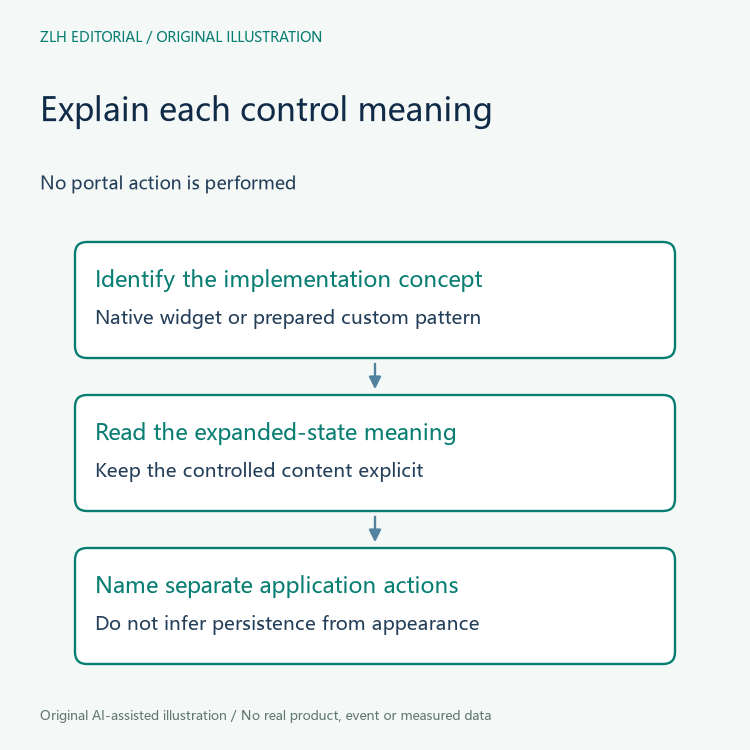
This article implements no control and reports no assistive-technology behavior. A later evaluation of an actual page needs its real structure, interaction, and test context. Pattern documentation can guide that evaluation but cannot substitute for it.
Check labels and neighboring actions together
Read the proposed disclosure label without its icon. Can a colleague tell what additional information it reveals? Then read the proposed submission label. The two should express their different purposes rather than rely on placement alone.
In a fictional care-robot page, the help text might explain what a form asks for. That does not make it medical advice or establish that a care provider will respond. Keep service promises and technical interaction descriptions separate, and support any actual promise through the appropriate real source.
Also ask whether the additional content contains controls of its own. Their purpose should remain clear when the section is opened. Revealing a set of choices does not establish that one was selected or that the application stored it. Each meaningful action deserves an accurate description.
Finish with an account of what remains unobserved
A useful teaching note identifies the disclosure trigger, the additional content, the intended expanded-state meaning, and any separate submission action. Another reader should be able to reconstruct those roles without guessing that an animation represents a saved record.
If the prepared concept lacks a persistence explanation, record that as an application question. Do not infer storage from a visual state. Likewise, a closed section would not prove that information was deleted. The actual implementation would need its own authorized review.
More discussion appears in our care-robot portal section and the reading directory. Both original illustrations describe interface roles only, with no real user details, form submission, storage result, clinical observation, or completed care service.


