

Care Portal Acceptance: Review the Reflow Context
2026-11-02
Care Portal Acceptance: Review the Reflow Context
Reflow context matters when a buyer reviews an enlarged care-robot web portal. Larger text and an adaptable layout are related questions, but one should not be used as an unexplained substitute for the other. A receiving team needs to know what information and functionality remain available in the view it actually examines. This article proposes that interface acceptance review and evaluates no real care service or robot.
Define the reading task and the view under review
Ask the portal owner which task the page supports. Reading a service notice, reviewing account information, and operating a form can involve different content relationships. The acceptance checklist should identify the task rather than judge an enlarged screenshot in isolation.
The receiving note should also identify the page revision, viewport context, and enlargement arrangement actually reviewed. A design preview may show intended behavior without establishing the delivered implementation. Keep proposed layout and observed behavior as separate records.
For the fictional review, no user profile or care record is supplied. Prepare questions about content availability instead of inventing a participant or test session. Older users should not be treated as one uniform accessibility profile, and an interface observation should not imply an outcome for every individual.
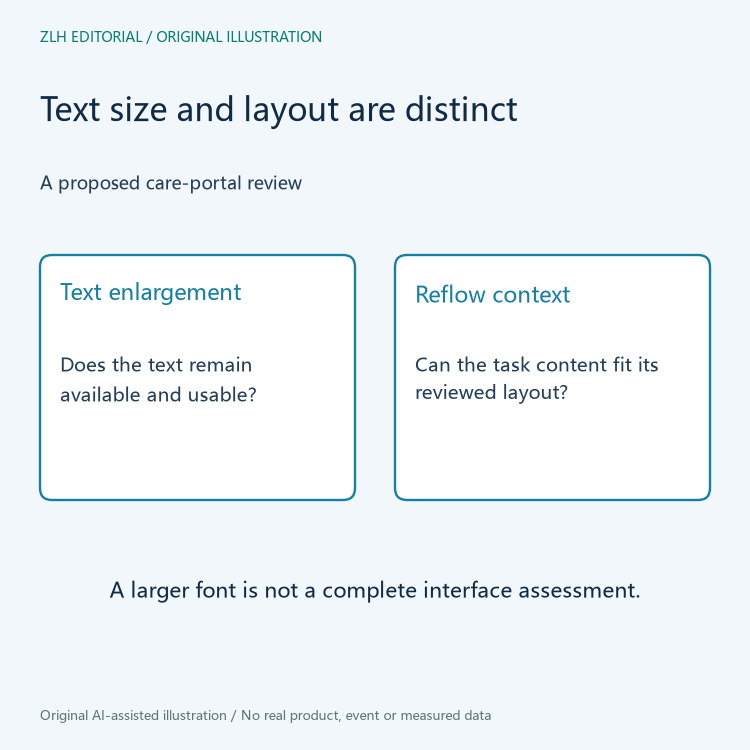
Keep text enlargement within its stated scope
The WCAG explanation of Resize Text describes enlarging text without losing content or functionality within the criterion’s scope and exceptions. A receiving review should use the full applicable requirements rather than reduce the question to whether letters became bigger.
Ask whether labels, controls, and relevant wording remain available in the actual reviewed arrangement. If the supplier provides an observation, retain its environment and scope. A picture of one enlarged paragraph does not establish that every page element behaves appropriately.
This article gives no numerical test report and performs no browser action. The official explanation provides the requirement context, not evidence that a particular care portal passed. A later authorized review must record the actual page and observation.
Ask the separate reflow question
The WCAG explanation of Reflow addresses presentation without loss of information or functionality and without requiring scrolling in two dimensions under its stated conditions. It also identifies exceptions for content whose use or meaning requires a two-dimensional layout.
The supplier should explain which content is being reviewed and whether a claimed exception actually concerns that content. A large table or diagram does not automatically exempt the surrounding page. The receiving note should retain the specific relationship instead of applying an undifferentiated exception label.
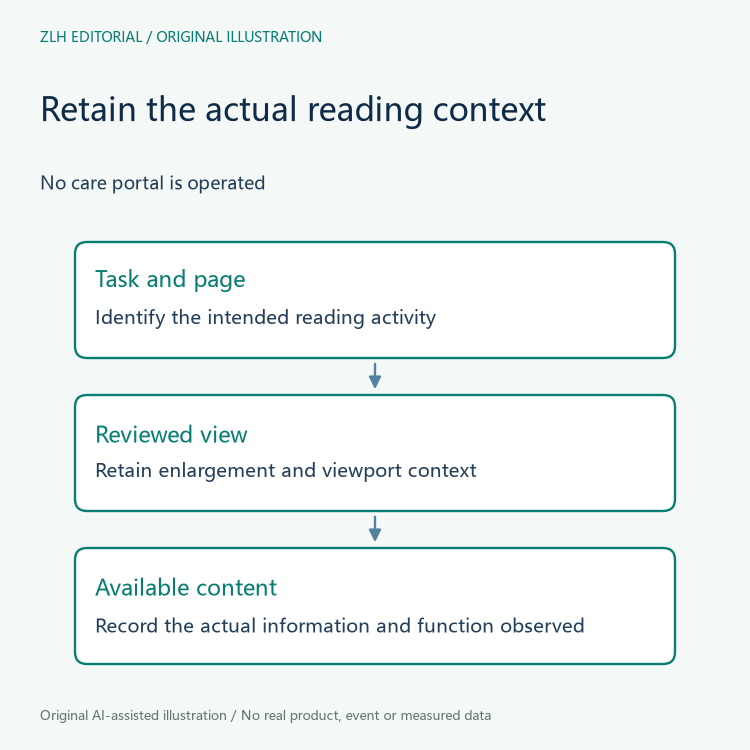
Text enlargement and reflow can therefore support different acceptance questions. A readable larger font does not alone explain whether a user can follow the content without repeatedly moving across both dimensions. The actual task and layout context need to remain visible.
Review availability rather than appearance alone
A proposed exercise should ask whether the relevant information, controls, and task relationships remain available. A tidy screenshot can conceal content outside the visible area or omit a later task step. The supplier should identify what was actually examined.
If content is unavailable in the reviewed view, preserve the observation and ask for the relevant explanation or correction. Do not silently remove the content to make the layout look successful. That changes the acceptance object rather than demonstrating the original requirement.
Keep interface conclusions separate from care outcomes
An enlarged or reflowing web page does not establish that a care robot is effective, clinically appropriate, or usable by every intended person. Those questions require their own evidence and responsible assessment. The current review concerns a bounded web-interface task.
Likewise, a single interface issue should not become an invented account of harm or failed care. Record the actual observation and its scope. The acceptance discussion should ask for evidence rather than fill uncertainty with a dramatic but unsupported case.
Where a stronger accessibility conclusion is needed, identify the remaining work. Checking these two aspects is not a complete conformance assessment. A clear review boundary helps the buyer understand what was examined and what still needs attention.
Accept an attributable layout review
The handover should connect the reading task, page revision, enlargement and viewport context, applicable requirements, and actual observations. Unexamined content can remain an open item. Another reviewer should be able to understand the limit without reconstructing the original demonstration.
When the portal changes, ask which earlier observations need renewal. Preserve the prior page context with its own evidence. A familiar visual style does not establish unchanged task availability after content or control revisions.
More interface notes appear in our care robot portal section and the reading directory. The original diagrams contain no real care records, user tests, browser screenshots, accessibility scores, or claimed service outcomes.


