

Care Portal Logins: Read the Memory Burden and Field Purpose
2026-11-04
Care Portal Logins: Read the Memory Burden and Field Purpose
Care portal logins can ask a person to remember account details, interpret a challenge and complete several input fields before reaching a service. Current WCAG explanations provide a way to examine the cognitive burden of that process. They also explain why the purpose of a user-information field matters to supporting technology. Reading these documents together helps a procurement team ask precise questions about a companion website without treating a web review as a judgment about the physical care robot.
Existing-user authentication has a defined scope
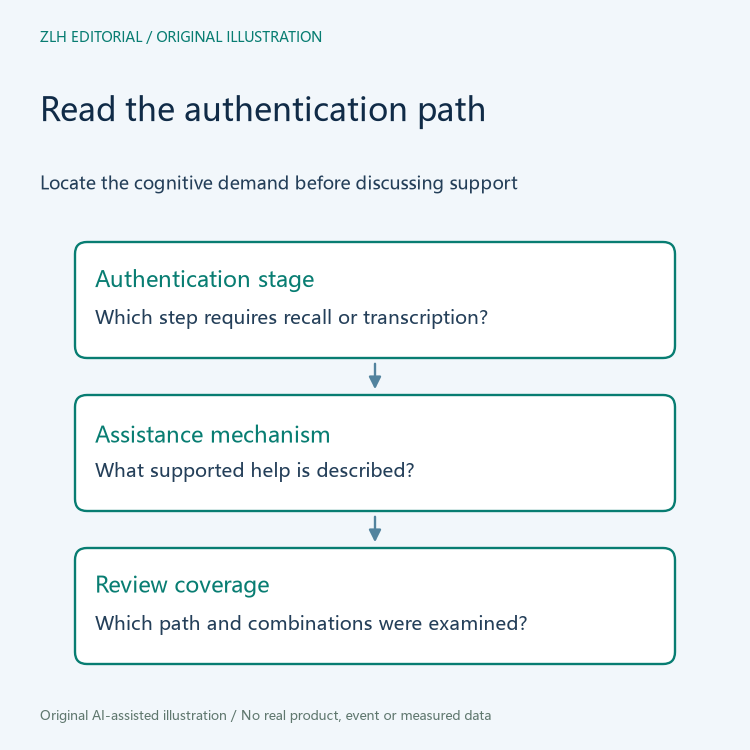
The W3C explanation of Accessible Authentication Minimum discusses cognitive function tests in authentication, with specified alternatives, assistance mechanisms and exceptions. It gives password-manager support and copy-and-paste as examples of assistance. The explanation concerns an existing user's authentication process and should be read with its conditions intact.
A team should therefore describe the actual step being considered. Remembering a password, transcribing a value and locating a field are different demands. A general statement that a login is simple does not show which demand a proposed design reduces. Nor does an isolated successful attempt establish that every route through the account process has been examined.
The cited Understanding page is informative guidance about a success criterion. It is useful for interpretation, but a review needs the applicable normative requirements and a defined scope before making a conformance conclusion.
An assistance mechanism needs a usable place in the process
When a supplier describes support for a password manager, ask which fields and account states the statement covers. The same question applies to pasting an authentication value. These are proposed review questions, not a finding that a named portal has blocked either feature.
The receiving team can request an explanation of the intended user path, including what happens when a previously saved value is unavailable or incorrect. That explanation should identify supported assistance without assuming that every older user has the same device, browser or preferences. Individual needs cannot be inferred solely from age.
Any subsequent review should use an authorized test environment and the organization's approved account process. This article does not collect account details or attempt a login. It also offers no method for bypassing a challenge, disabling authentication or replacing a security control with an unreviewed workaround.
A field's purpose is more specific than its visual appearance
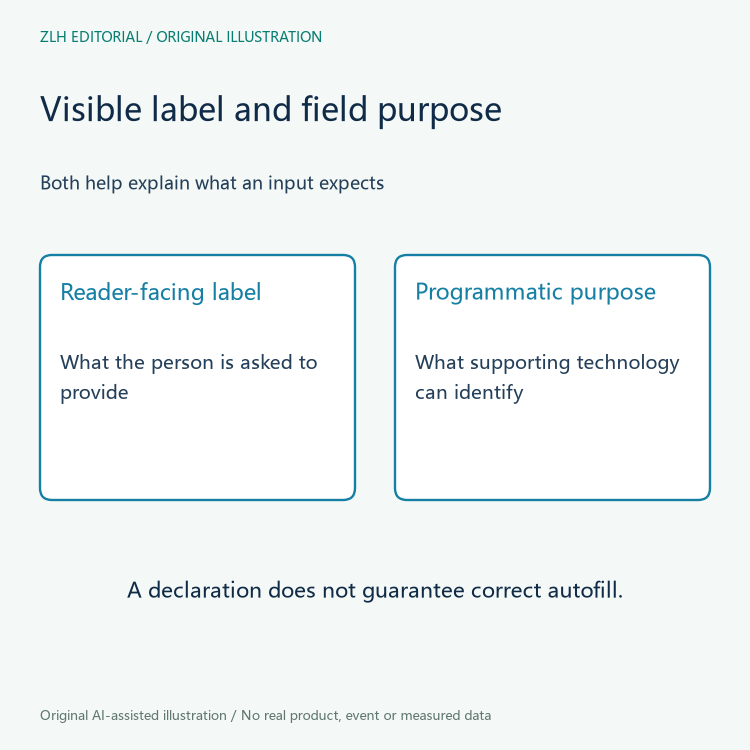
The W3C explanation of Identify Input Purpose concerns supported ways to determine the purpose of identified user-information inputs programmatically. It distinguishes broad input types from more specific purpose information, including the HTML autocomplete approach. Its conditions do not cover every arbitrary field in every technology.
For a care portal, a visible field label helps the reader, while programmatic purpose can help supporting technology interpret what the field expects. Those roles should be documented together. A field looking like an email box does not tell a reviewer whether it requests the account holder's address or another person's contact information.
The presence of a purpose declaration does not guarantee correct filling in every browser or password manager. A supplier can explain its intended markup, but a claim about a particular supported combination should have corresponding evidence. Unchecked combinations should remain outside the stated review coverage.
Authentication assistance and security need coordinated review
Reducing unnecessary cognitive effort does not authorize an editor to decide who may access an account. A procurement discussion should identify which team owns the security assessment and which evidence supports the accessibility observations. One kind of review should not silently stand in for the other.
Consider a proposed shared-device scenario: the team would need an approved account and privacy design appropriate to that context. This is a question to resolve, not a real deployment described here. The article does not recommend storing credentials on a shared device or infer that a password manager is suitable under every organization's policy.
Likewise, successful access to a companion portal does not demonstrate that an associated robot is clinically effective, physically safe or usable for every care task. Those broader claims require evidence about their own objects and outcomes.
Keep the review conclusion attached to the examined path
A clear record identifies the authentication stages discussed, the assistance mechanisms described, the field-purpose information reviewed and the combinations left unexamined. It should distinguish a supplier statement from an observation made by an authorized reviewer. A missing observation can remain a follow-up item rather than becoming an invented success result.
The original diagrams contain no credentials, actual login screen or user-study data. Related reading is available in the eldercare service-robot procurement collection and the article directory. Reading memory burden and field purpose together gives care portal discussions a more specific basis while preserving the boundaries of the evidence.


