

Care Portal Language: Read Page and Passage Context
2026-11-04
Care Portal Language: Read Page and Passage Context
A care-robot supplier may offer a portal with several language choices, but a language menu tells a procurement reviewer only part of the story. The language of the selected page and the language of a passage inside it can require separate attention. This portal language exercise helps a buyer ask focused documentation questions. It concerns a fictional web interface and does not establish that a robot is usable by a resident or that any care service is suitable.
Choose a reading task instead of an audience stereotype
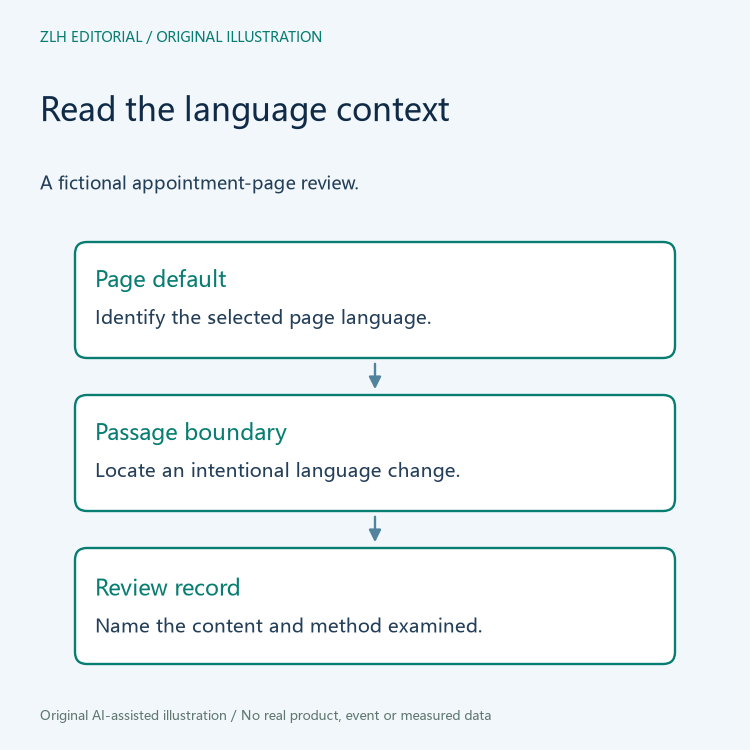
Start with a task such as reading a service appointment explanation. Identify the selected interface language, the particular page and the text needed to complete the reading task. Do not assume that all older people use the same language, reading method or assistive technology. A procurement brief can describe the languages it intends to support while leaving room for individual preferences and support needs. This is more informative than a claim that the interface is universally understandable.
For a hypothetical example, imagine an English appointment page containing a short Spanish explanatory paragraph supplied by a service partner. The example has no resident names, dates or clinical information. A reviewer should first establish whether the paragraph is intentionally Spanish or is an untranslated fragment. Those possibilities require different follow-up questions. Neither its appearance nor the presence of a translation button explains what language information the underlying page provides to software.
Find the default language of the actual page
W3C's Understanding Language of Page explains WCAG 2.2 Success Criterion 3.1.1, a Level A criterion concerning programmatic determination of a page's default human language. The informative explanation discusses presentation and pronunciation. It does not say that selecting a language proves translation quality or that every assistive technology will produce identical speech.
In the fictional procurement review, ask the supplier to identify the page's declared default and to relate it to the visible appointment content. Record the page version and selected language rather than accepting a screenshot of the language menu as the complete answer. If the same portal provides different language versions, keep their observations separate. A declaration suitable for the English page does not answer what the Spanish version declares after navigation or what a later confirmation page uses.
Read a changed-language passage in its own context
The separate Understanding Language of Parts discusses Success Criterion 3.1.2 at Level AA. Its scope includes passages or phrases and exceptions for proper names, technical terms, indeterminate language and language adopted into surrounding usage. The explanation also warns that some assistive-technology presentations flatten accessible names, so spoken output alone cannot settle every markup question.
Return to the invented partner paragraph. The useful review asks where the language changes, which content is inside that boundary and what the page exposes there. Avoid flagging every foreign-looking product name as a failure without considering the criterion's exceptions. Conversely, do not dismiss a complete paragraph as merely a brand label. Ask the supplier to explain the particular text and its context. Preserve enough surrounding wording to show why it was treated as a passage rather than an isolated proper name.
Separate markup findings from a user's reading experience
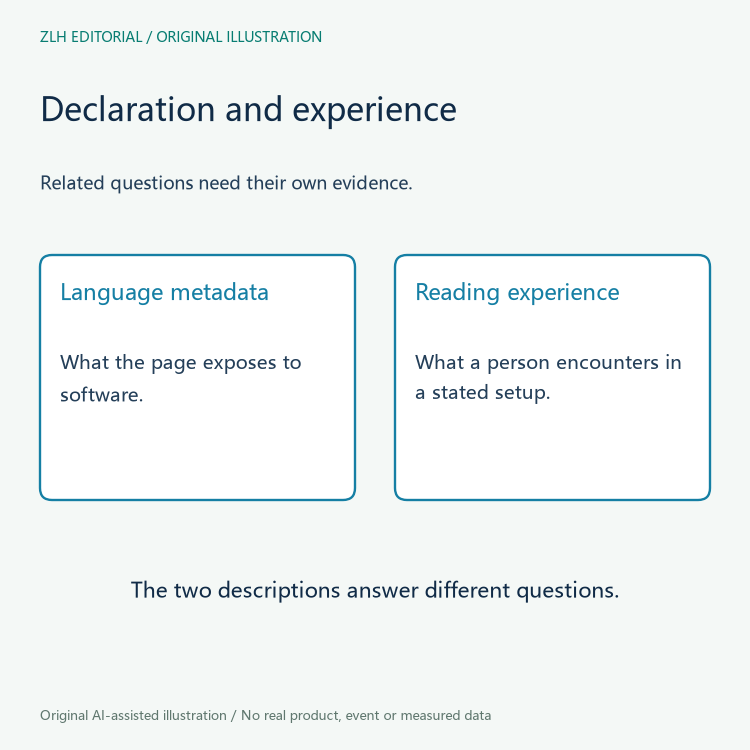
A documented language declaration is one observation. A person's experience reading or listening to the appointment explanation is another. Both can be useful, but they answer different questions. If a review includes a listening observation, identify the browser and assistive-technology configuration actually used. Do not claim such an observation when only source documentation was examined. Pronunciation behavior may depend on settings and available language support as well as the page.
Likewise, an accurately declared Spanish paragraph does not prove that an English reader understands it. The procurement team may still need an agreed translation workflow, an understandable way to change language and a plan for service content supplied by partners. Those are questions to document against the proposed service. This article does not supply a translation assessment, test results or a care recommendation. A narrow metadata finding should remain narrow even when it is encouraging.
Make the supplier's response checkable after content changes
A practical response can name the appointment page, its default language, the reviewed passage and the method used to examine language information. If the supplier changes a template, ask whether the same content boundary is still represented in the revised page. If a partner replaces the paragraph with text in another language, record that content change separately from the template change. This keeps a previous observation from silently becoming approval of a new page.
Close with the questions that remain open: which language versions were included, which passages were sampled and which reading paths were outside the review. Such a record helps a buyer commission further work without presenting a small check as a complete accessibility evaluation. The portal is one component of a broader service. Our technical information category and related resources category offer broader navigation for documentation reading; the links are category routes rather than claims about a specific care product or completed evaluation.


