

Care Portal Instructions: Name Controls at Acceptance
2026-11-04
Care Portal Instructions: Name Controls at Acceptance
A care-robot portal may tell a person to use the round button on the right. That instruction can look obvious in one screenshot while leaving other readers unsure which control it means. Portal instructions should identify the intended action through evidence a reviewer can follow, including the control's name and task context. This article describes a fictional acceptance review of web content, without evaluating a robot, collecting resident details or claiming a complete accessibility audit.
Choose the instruction and the task it supports
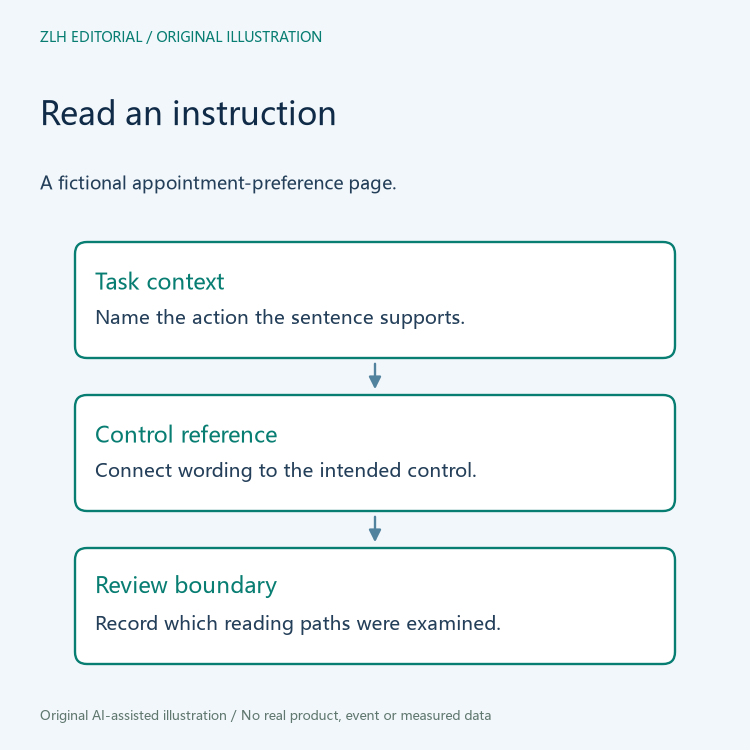
Imagine a hypothetical appointment-preference page. Its help text tells a person to select the blue control after choosing a preferred contact method. No actual appointment or personal information is involved. The reviewer first identifies what action the sentence is intended to support and where the relevant control appears in the selected page state. A sentence detached from its task may be impossible to evaluate fairly.
Retain the exact wording with the nearby control labels. If the help text appears only after another action, that state belongs in the record too. Do not assume that all older people will understand or misunderstand the same cue. The procurement question is whether the proposed instructions identify the action adequately for the intended reading paths, with individual needs considered through appropriate later evaluation.
Read sensory cues as supplementary information
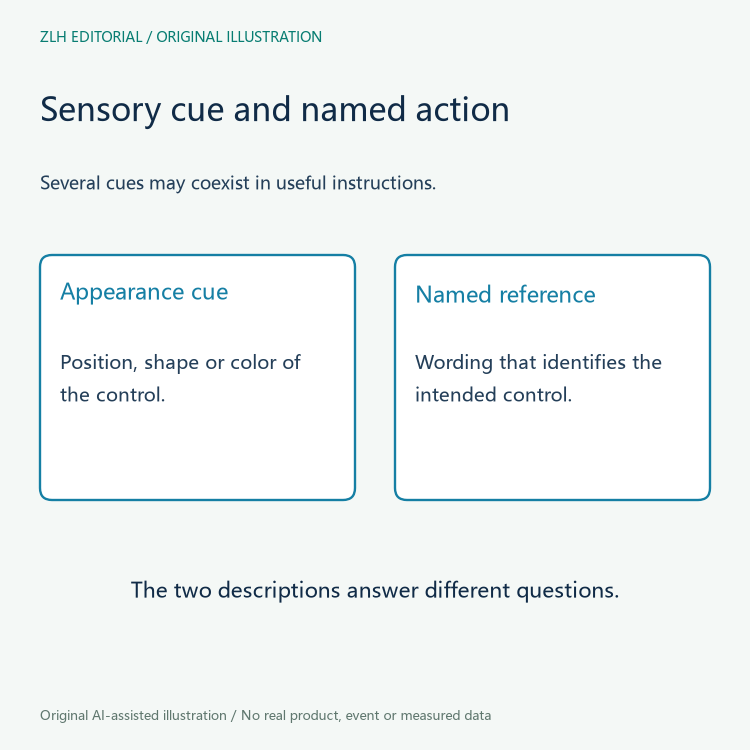
W3C's Understanding Sensory Characteristics explains WCAG 2.2 Success Criterion 1.3.3 at Level A. Instructions must not rely solely on sensory characteristics such as shape, color, location or sound. The explanation allows such cues when information is also provided another way. It does not require removing every positional description from a page.
For the fictional blue control, the useful question is whether the sentence also identifies the control in a way that does not depend only on that appearance. A named control can provide another reference point. The reviewer should connect the wording to the actual control under discussion, rather than suggest a generic replacement that might name a different action. An instruction mentioning both a label and location can be examined on its own terms.
Keep input guidance separate from technical association
The separate Understanding Labels or Instructions explains Success Criterion 3.3.2, also Level A, for content requiring user input. It distinguishes providing guidance from correctly marking up relationships and accessible names, which other criteria address. A visible instruction and a programmatic association are related review questions, rather than interchangeable evidence.
In the invented appointment page, a sentence might clearly explain what contact preference is expected, while a separate examination would be needed to understand how the control is represented to software. Conversely, a technical name alone does not show that all readers receive adequate visible guidance. An acceptance note should state which question was examined, so a limited wording review does not become an unsupported assertion about every interaction mode.
Review the same instruction after layout changes
Suppose the fictional supplier changes the layout so the target control moves below the content. An instruction based only on right-hand position now needs attention. A review can identify the old sentence and the new layout relationship without claiming that every page is affected. If a stable descriptive label remains available, record how the revised instruction uses it. Preserve the prior wording with the revision request.
Do not treat a screenshot correction as proof that the whole reading task has been completed successfully. A screenshot can show the new words and arrangement, while other interaction observations may still be outstanding. If a demonstration is later performed, record the actual page state, task and method used. This article reports no such demonstration and supplies no conformance result for a real portal.
Leave a focused procurement finding
A useful finding quotes the instruction, names its intended control and explains which identifying information remains dependent on appearance or position. It can request a specific wording revision and identify what should be checked again. The supplier's response should remain tied to that page and version. Avoid broad statements that the service is suitable for all residents merely because one sentence is clearer. The procurement file can also identify who owns the help text and who owns the control label, so a later wording change has a clear review route. This is an editorial responsibility question, rather than a claim that any particular supplier already follows such a process.
The acceptance outcome sought is an attributable account of how the instructions identify the action, with unexamined relationships kept visible. Portal access is one part of a larger care-service decision. Our technical information category and related resources category offer further navigation for procurement-document reading. These links identify categories and do not certify a care product, clinical benefit or completed accessibility evaluation.


