

Care Portal Link Purpose: Maintain Meaning in Revisions
2026-11-04
Care Portal Link Purpose: Maintain Meaning in Revisions
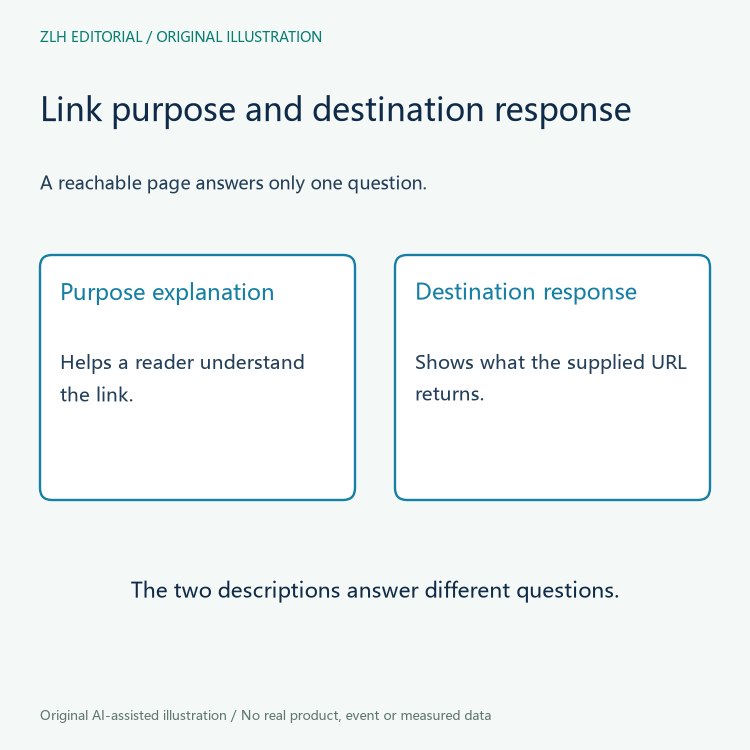
Link purpose can become unclear when a care portal revises its guidance but retains an old label. A maintenance review should consider what the link tells a reader, which associated context explains it and where the destination now leads. Merely confirming that a URL returns a page is not the same review. This article discusses a fictional documentation change, not a real care service, and reports no user testing or accessibility certification.
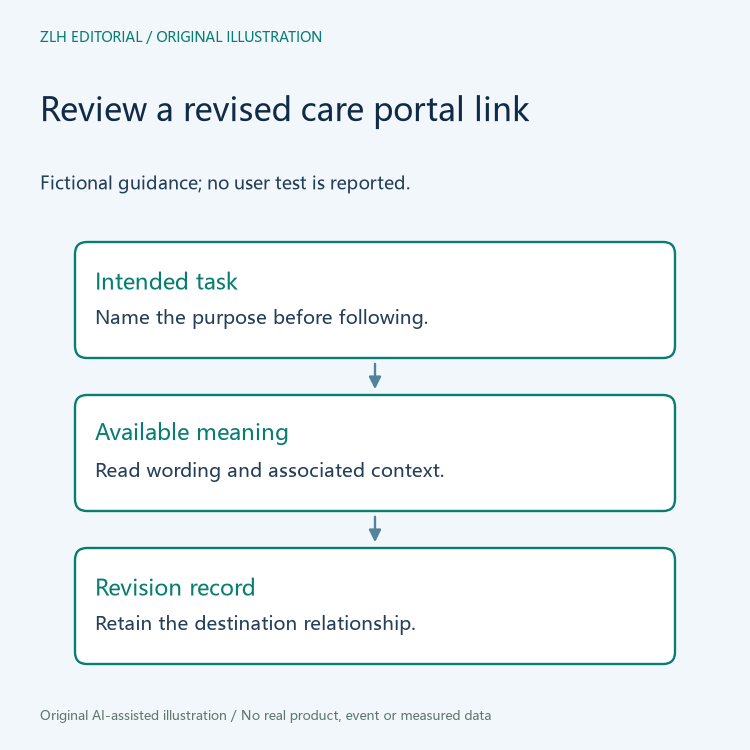
Identify the task the link is meant to support
Imagine a fictional portal that changes a general information page into a document describing support contact options. An old link still says More. The reviewer should ask what a reader is expected to understand before following it. The destination change and the surrounding sentence belong in the same maintenance discussion, because a label that once had enough context may no longer describe the revised material clearly.
Record the source page, link wording, nearby explanation and destination version. Do not assume that a working destination makes the wording adequate. Equally, do not conclude that every short link is defective. The question is the meaning available in the relevant context. This fictional example establishes a review method, not an observed difficulty for older people or a claim that all care portal users have identical needs.
Read purpose through text and associated context
The W3C explanation of WCAG 2.2 link purpose in context describes determining a link's purpose from its text alone or together with programmatically determined link context, with a defined exception. It also discusses helpful ways to provide context. This is explanatory guidance for the criterion, not a finding about the fictional portal or an obligation that every link must be long.
For the fictional revision, ask which words supply the purpose and how they relate to the link. A sentence in an unrelated page region should not be assumed to provide the required association. The review should preserve the actual relationship rather than simply pasting a paragraph somewhere nearby and declaring the task solved. Any implementation assessment needs the delivered page, not just the editor's intended wording.
Review headings without treating them as automatic context
The W3C explanation of headings and labels says that supplied headings and labels describe topic or purpose, while distinguishing that issue from correct structural identification. This provides another maintenance question: does the revised section heading still describe its content? A clear heading is useful, but it should not be treated as automatic proof that every link has sufficient associated context.
In the fictional portal, a section may contain several different destinations beneath one broad heading. Review each link's intended purpose rather than allowing the heading to stand in for all of them. Preserve whether the discussion concerns wording, structure or destination content. These topics are related, yet an improvement to one does not establish a complete result for the others.
Keep editorial intent separate from interaction evidence
A provider can explain that a revised label is intended to help readers locate support options. That is an editorial intention. Whether particular readers understand and operate the delivered portal requires suitable observation, which this article has not performed. Do not turn an approved phrase into a claim that a care product is usable or that a person will receive a timely response from its service team.
If the maintenance pack includes test evidence later, retain the page version, task, environment and observed behaviour. A label change may be one relevant factor, but the report should not invent a causal explanation without supporting material. The fictional scenario contains no participants or measured outcomes. It only identifies the documentation needed to keep an intended navigation purpose understandable across revisions.
Write a revision note another reviewer can follow
A useful note names the old and new link purpose, the wording and associated context reviewed, and the destination version. It can state which parts remain unexamined. If a URL is unchanged while its content changes, keep that distinction visible. A stable address does not mean the source label continues to describe the destination accurately, and a new address does not by itself require inventing a new purpose.
Retain the reason for the revision in plain language. For example, the fictional provider may say that the destination now explains contact channels rather than general guidance. Mark that as the provider's explanation and keep the relevant material. The next editor can then revisit the intended relationship when the destination changes again, instead of inheriting an unexplained checked box.
Related methods are organised in the technical material category and related resource category. Those categories do not evaluate a specific care service. Keeping link wording, context and destination together gives the portal maintenance record a concrete object and leaves broader usability and service claims with the evidence they need.


