

Care Portal FAQ: Read Focus Order and Visual Layout
2026-11-05
Care Portal FAQ: Read Focus Order and Visual Layout
Focus order in a care portal needs a meaningful relationship to the task, but a screenshot alone does not reveal the sequence encountered during keyboard navigation. A review should identify both the visible arrangement and the actual sequence being discussed. This FAQ reads W3C accessibility guidance through a fictional service page. It does not operate a real portal, submit an appointment or claim that a page satisfies an accessibility requirement.
Does focus have to follow every visible position exactly?
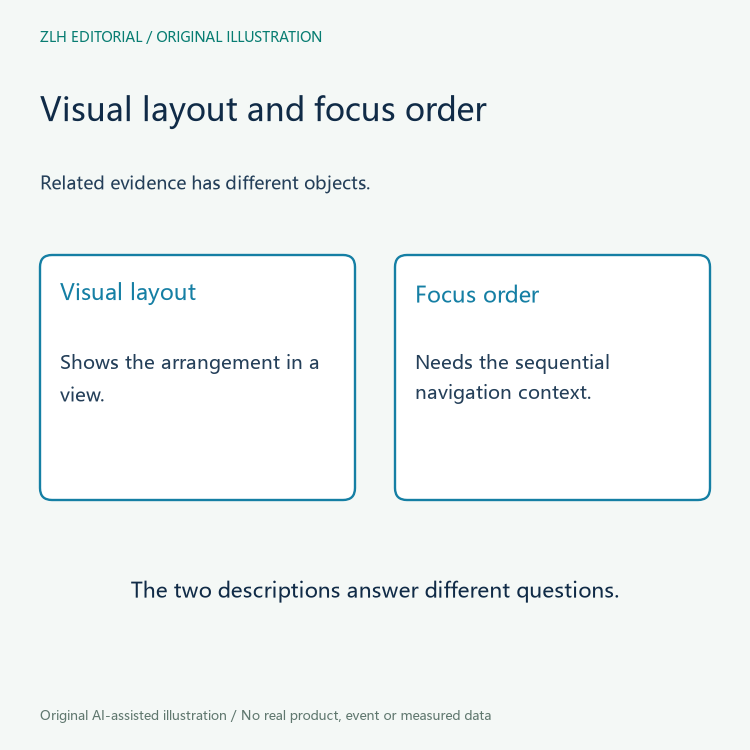
The W3C explanation of Focus Order says that sequential navigation must preserve meaning and operability where sequence affects them. It explains that more than one order may reflect logical relationships and that focus order need not mechanically follow visual layout. That qualification should be read with the requirement to avoid confusing or illogical navigation, rather than as permission to disregard the visible task.
Imagine a fictional care page with independent information sections and an associated request area. A reviewer should ask how the sequence relates to those sections and their intended use. Do not decide from column position alone that a particular order is required or acceptable. The explanation needs the relationships that make the page understandable, together with evidence of the sequence actually encountered.
What can a screenshot establish about the sequence?
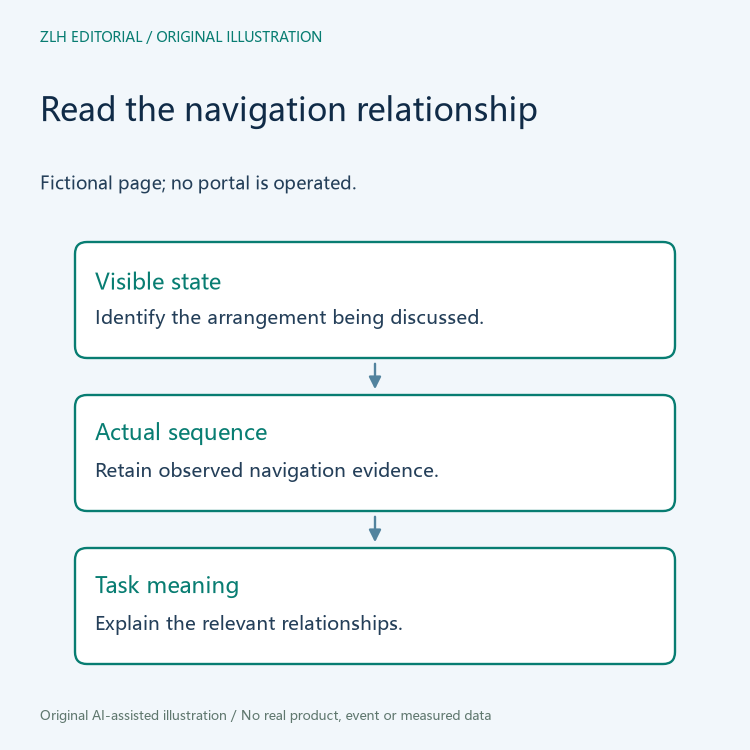
A screenshot can document an observed arrangement at a particular state, but it does not by itself show every sequential focus transition. The fictional review should separately identify the view and the interaction evidence. If someone supplies only a static image, record that limitation. Do not add arrows and then present them as a traced keyboard route unless that route was actually observed and documented.
This distinction also matters when a page has multiple states. A picture of an expanded area is not an observation of how focus reached it or where focus moved next. The reviewer can ask the provider to identify the starting state, relevant controls and observed sequence. This article has followed no such sequence, so its conceptual illustration contains documentation stages rather than a fabricated portal trace.
What does the placement technique contribute?
W3C Technique G59 describes arranging interactive elements so default focus order follows the sequences and relationships in the content. It also states that techniques are examples of ways to meet WCAG, not mandatory implementations in themselves. A reviewer should preserve that status and avoid treating one technique as the only possible design or as a certificate for a particular page.
For the fictional handover, ask how the provider's chosen arrangement reflects the task relationships. A source-order explanation can be useful documentation, but it is not a substitute for an actual observation if the claim concerns behaviour. Equally, a recorded sequence needs enough page context for another person to understand why it preserves the intended relationship. Keep the design explanation and the observed interaction linked but separately identifiable.
Can a logical sequence prove the whole portal is accessible?
A bounded finding about one navigation sequence does not establish every other aspect of a portal. The fictional reviewer should identify the page, state and interaction scope examined. Avoid expanding a local observation into a statement about all forms, appointments or users. The official guidance explains a particular criterion and technique; it does not report how an unexamined service performs.
If a provider later changes the visual arrangement, retain the revision relationship and ask whether its navigation evidence still applies. Do not automatically reuse an earlier conclusion for a changed page. The original review can remain useful context while the new layout has its own documentation needs. This is a recordkeeping question, not a claim that a particular redesign introduced or fixed a barrier.
What should a precise FAQ answer retain?
Retain the visible state, the task relationships, any actual sequential-navigation record and the explanation of how that order preserves meaning and operation. Say which items have been supplied and which remain open. A diagram should label these objects without pretending to be a real user's journey. No user session, navigation failure or completed care request has been observed for this article.
A short finding can therefore describe a specific relationship rather than awarding a broad pass from a screenshot. When evidence is incomplete, identify the missing sequence or context. The next reviewer can then request the relevant material instead of repeating a vague question about whether the page looks orderly.
Additional methods appear in the technical material category and related resource category. These are reading categories, not portal assessments. Keeping focus order, visible layout and task meaning connected through explicit evidence gives care portal documentation a more useful basis for review.


