

Care Device Event Records: Last Time and Event Type
2026-11-05
Care Device Event Records: Last Time and Event Type
An ordinary activity button may appear alongside service robots in a care-device dashboard. Its record can contain a date and time where a reader expects an on or off label. Home Assistant's event entity explains that representation: its state records the last event's timestamp, while an Event Type attribute identifies the kind of event last emitted. Understanding these two roles helps a handover editor describe the record without inventing a continuously held button state or a completed service response.
A momentary event has a different representation
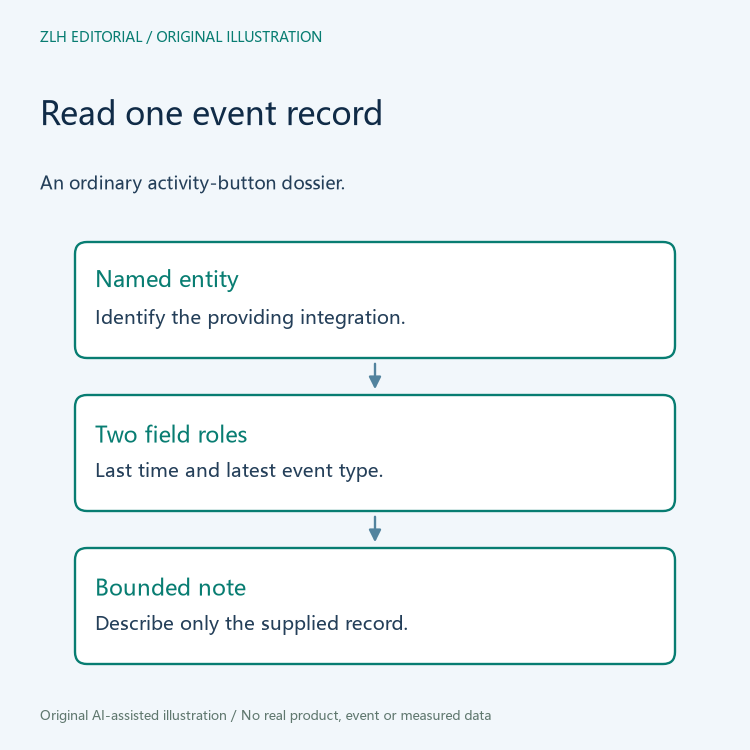
The official Event integration page describes signals from momentary physical interactions, such as a remote button press. These events do not have a lasting on or off state in the traditional sense. The integration is a building block used by other integrations, rather than a standalone connection to any arbitrary device. A device dossier therefore needs to identify the integration supplying the entity before its fields are interpreted.
The contributor documentation makes the same distinction and suggests a binary sensor for a condition that remains on for a period. That is useful vocabulary for reading a supplied dashboard specification. It is not a reason to assume that every button, motion detector or care accessory uses an event entity. The object declared in the actual project record remains the starting point.
The state says when the last event was recorded
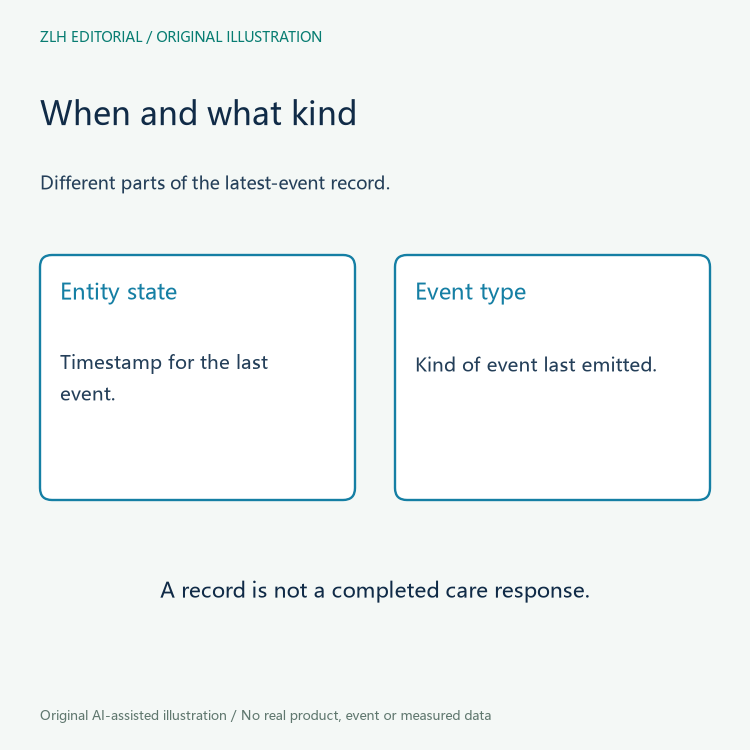
The Event page defines an event entity's state as a timestamp showing the date and time when the last event was detected. It describes UTC storage and local date-and-time presentation in the interface. A human-readable card can therefore look different from an underlying stored value without that visual difference proving that the device reported a second interaction. The page also identifies unknown and unavailable states, so a reviewer should preserve those labels when supplied.
The contributor reference describes the timestamp representation and the initial unknown state before an event. Its explanation of restoring the last event after a restart is another reason to avoid treating a visible timestamp as proof that a new interaction just occurred. The article does not reconstruct an actual timeline, compare clocks or calculate response intervals; it reads the documented meaning of the entity state.
The event type says what kind was last emitted
The separate event_type attribute holds the type of the last event. The official user-facing page illustrates distinctions such as a single press and a double press when a device can emit those variations. The attribute therefore answers a different question from the timestamp. Copying a date into an event-description column loses the interaction kind, while copying a type label into a time column loses when that last event was represented.
The developer page distinguishes the possible event_types list from the latest event_type attribute. The list describes what the entity can emit; it does not mean that all listed interactions occurred. This distinction matters in a handover appendix that combines a capability description with a current record. A supported variation and a reported latest variation should retain their different headings.
Read a fictional button record without adding an outcome
Suppose a fictional routine-activity button dossier contains a timestamp and a type labelled as a short interaction. The editor can state that the supplied event record identifies its latest time and interaction type. It cannot establish, from those two fields alone, that a person intended a particular request, that a staff member received it, or that any assistance was completed. This invented example concerns documentation, with no real resident or monitored device.
If the dossier's summary says that the button is still being held, ask which separate record supports that ongoing condition. The latest momentary event may not answer that question. If the summary promises a completed response, ask for the relevant response account instead. These are different evidence gaps, and correcting the field headings does not fill them.
Keep the entity definition beside the handover note
A useful note names the entity and its providing integration, preserves the supplied state and attribute labels, and explains their roles. It should distinguish what the current excerpt shows from any capabilities listed elsewhere. This does not require creating an automation, pressing a button or sending a notification. The reading exercise can remain entirely within the submitted materials.
The inspected Home Assistant documentation is an evolving software reference, so a project should retain its own applicable version context. Related material appears in the site's care-device document collection and service robot reading notes. A precise event note keeps when and what kind separate, while any conclusion about human care, delivery or response remains attached to independent evidence.
Primary references: Home Assistant Event integration; Home Assistant contributor reference for event entities.


